The $140 Billion
Math Problem.
The state's refusal to allow private ownership models is not a policy preference. It is creating an unfunded liability that will bankrupt the system. These are not projections. They are the state's own numbers.
How We Got Here
When Pennsylvania closed Pennhurst in 1987 and Byberry in 1990, it made a commitment — implicit in every court order and every piece of deinstitutionalization legislation — to fund community living for the people it had warehoused. In 1991, the state put a price tag on that commitment through its CHIPP program (Community and Home Integrated Program of Pennsylvania): approximately $125,000 per person per year to provide community-based services to one adult with an intellectual or developmental disability.
The CHIPP benchmark and the $140B liability calculation apply exclusively to Pennsylvania's intellectual and developmental disability (IDD) population — the same population served by Pennhurst, and the same population Front Porch Cohousing exists to serve today: adults with autism, Down syndrome, cerebral palsy, traumatic brain injury, and related conditions. Byberry served a psychiatric population under a separate funding stream. The $140B figure is not a combined estimate — it is the IDD liability alone, drawn from the state's own Office of Developmental Programs (ODP) data.
That $125,000 figure was already high. Adjusted for 35 years of inflation and the escalating complexity of the current system, the state now spends an average of $318,000 per person per year on state-funded IDD services — a 154% real increase since the state made its original community living commitment.
This is not a crisis of compassion. Pennsylvania's IDD system is staffed by dedicated people doing difficult work. This is a crisis of structural design. The state built a system that can only function at scale if it controls the housing. It never built a pathway for private ownership. And now it is writing rules that actively prevent one from being built.
One Person. One Number.
$44 Million.
Consider a single 32-year-old adult with IDD today — someone like the adults Front Porch Cohousing is building for. If they live to age 80, the state is facing an unfunded lifetime liability of $33 to $44 million for that one individual under the current service model.
That is not a rounding error. That is a mortgage-sized liability for every single person on the waitlist — a liability the state has no funded plan to meet.
(48 years × $318K, no inflation)
(with 2% annual cost inflation)
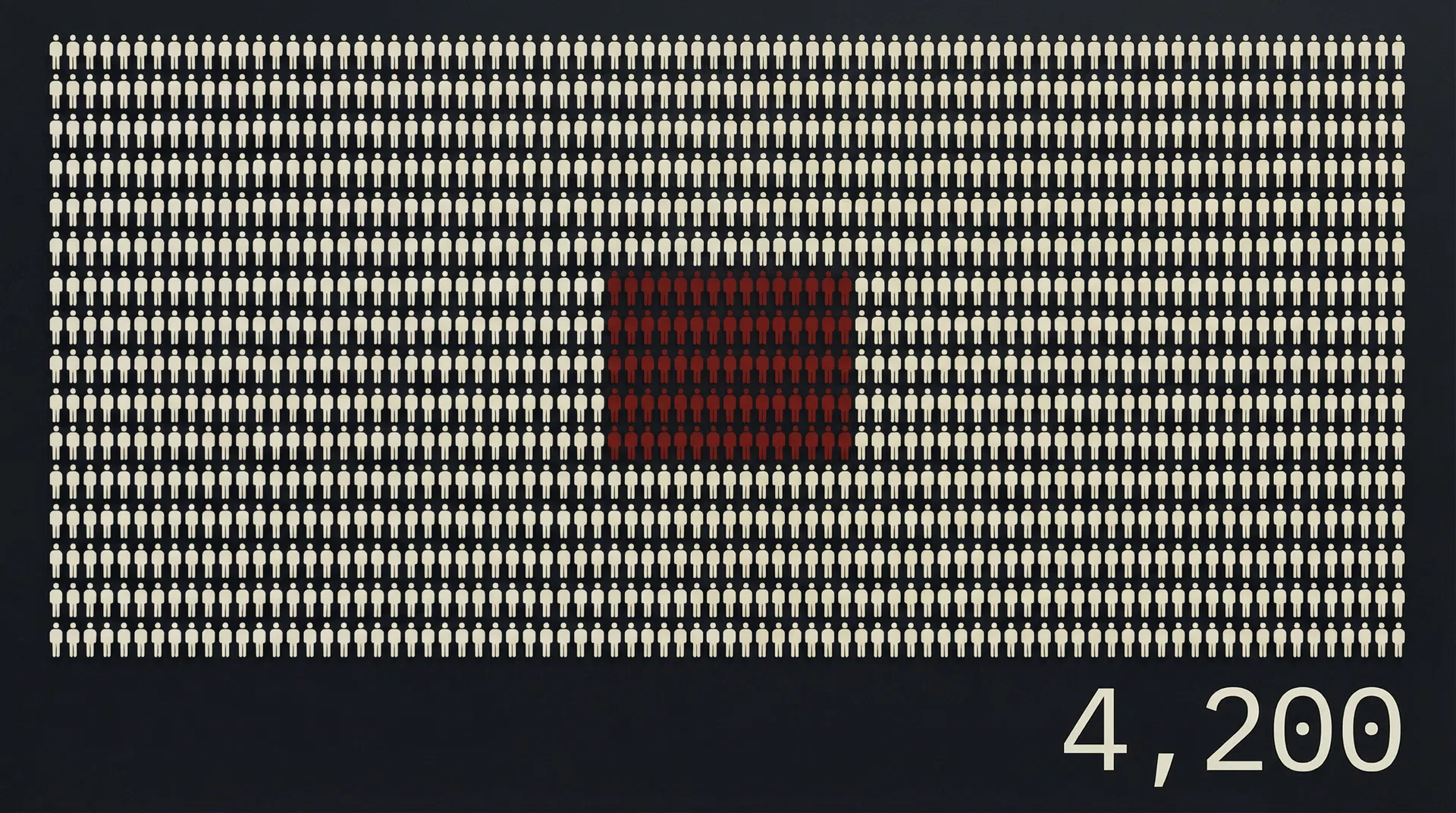
4,200 People.
$140 Billion.
There are currently 4,200 people on Pennsylvania's "Emergency" IDD Waitlist — people whose need for services has been formally designated as urgent by the state's own Office of Developmental Programs. Multiply the $33–$44 million lifetime liability by 4,200, and the state is sitting on a $140 billion to $185 billion unfunded liability.
They simply cannot afford to solve this problem using the existing regulatory framework. The math does not work. It has never worked. And the state's own rules are preventing the private sector from offering an alternative.
"The state has the data. It has had the data for 40 years. And it has continued to write rules that perpetuate the crisis."